

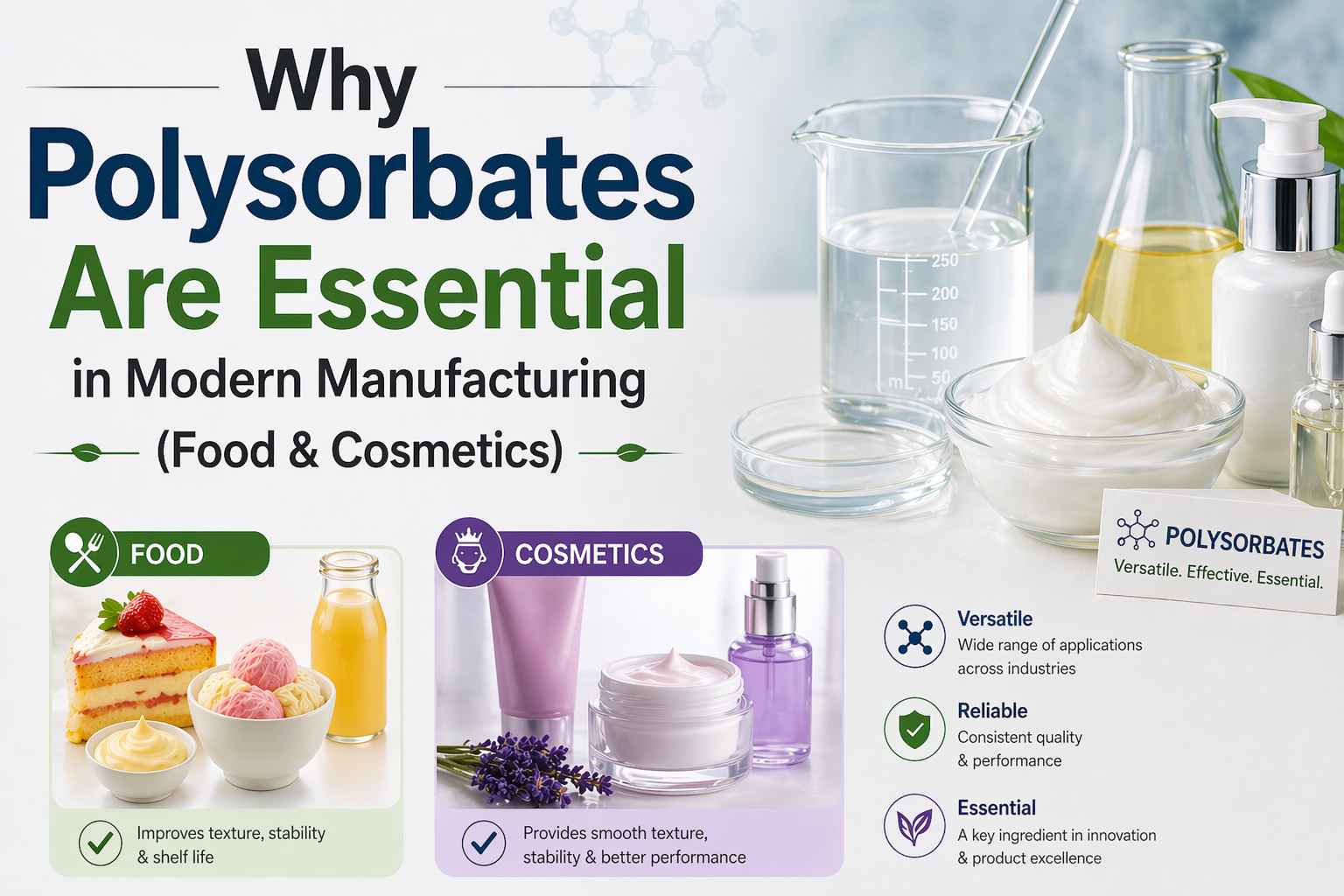
Ask any seasoned formulator what ingredient they’d hate to lose, and polysorbates will probably come up before the conversation ends. They’re not flashy. They don’t make marketing headlines. But walk through a manufacturing facility producing ice cream, injectable solutions, or luxury serums, and you’ll find them quietly doing the heavy lifting.
That’s the thing about polysorbates, all of them i.e., polysorbate 20, 40, 60 and 80. They’ve become so deeply woven into modern manufacturing that most finished products we use daily wouldn’t look, feel, or perform the same without them. So let’s unpack why these emulsifiers have earned such a central place across three of the most demanding industries on earth.
What Makes Polysorbates So Widely Used?
Polysorbates are non-ionic surfactants built on a sorbitol backbone, paired with fatty acids like lauric, stearic, or oleic acid. You’ve likely seen them labeled as Polysorbate 20, 40, 60, or 80, each variant tuned for slightly different applications.
Their real power lies in versatility. A single ingredient that emulsifies, solubilizes, stabilizes, and disperses. That kind of multi-functionality is rare, and it’s exactly why manufacturers across sectors keep depending on them.
The Role of Polysorbates in Food Manufacturing
Food production is unforgiving. Texture matters, shelf life matters, and consumer expectations keep rising. Polysorbates help manufacturers hit all three marks consistently.
Here’s where they typically show up:
- Ice cream and frozen desserts: Polysorbate 80 controls ice crystal formation, giving that smooth, creamy mouthfeel consumers expect.
- Baked goods: They improve dough handling, crumb softness, and freshness retention.
- Whipped toppings and dairy analogs: Polysorbates stabilize air incorporation, creating consistent volume and texture.
- Salad dressings and sauces: They prevent oil-water separation, keeping products visually appealing on the shelf.
- Beverages: Flavor oils and essential oils get solubilized evenly in water-based drinks.
Global food producers in the US, Europe, and across Asia rely on food-grade polysorbate suppliers for these exact reasons. When you’re running high-speed production lines, ingredient reliability isn’t optional.
How Do Polysorbates Improve Cosmetic and Personal Care Products?
Walk down any beauty aisle and pick up five products at random. Chances are, polysorbates are in at least three of them. They’ve quietly become a formulator’s best friend in personal care.
Their applications span nearly every category:
- Skincare: Lotions, creams, and serums rely on them for stable emulsions that don’t separate over months on a shelf.
- Haircare: Shampoos and conditioners use polysorbates to solubilize fragrances and essential oils.
- Micellar waters and cleansers: They create the gentle cleansing action that consumers have come to expect.
- Sunscreens: Polysorbates help disperse UV filters evenly across the skin.
- Fragrance and perfume bases: They solubilize oil-based aromatics into clear, water-based formulations.
- Color cosmetics: Stable pigment dispersion in foundations, lipsticks, and mascaras depends on consistent emulsification.
Cosmetic manufacturers in India, Korea, the EU, and North America continue expanding production, and demand for cosmetic-grade polysorbate in bulk has grown accordingly.
Why Are Polysorbates Gaining Demand in Global Manufacturing?
Several factors are driving the steady rise in global consumption.
Consumer products are getting more complex. Multi-functional formulations, hybrid textures, and active-rich products all demand better emulsification than basic surfactants can deliver. Polysorbates handle that complexity without adding process headaches.
Supply chain stability is another factor. Unlike some natural emulsifiers that fluctuate with agricultural cycles, polysorbates offer predictable availability and pricing. For procurement teams planning annual budgets, that predictability is worth a lot.
And then there’s regulatory acceptance. Polysorbates are approved across major regulatory frameworks globally, which simplifies cross-border manufacturing and exports.
Key Benefits for Manufacturers and Bulk Buyers
When you strip away the technical jargon, here’s what manufacturers actually value:
- Batch-to-batch consistency that keeps production lines running smoothly
- Scalable supply from small pilot runs to multi-tonne commercial orders
- Broad compatibility with oils, actives, fragrances, and aqueous systems
- Grade flexibility across food, pharma, and cosmetic specifications
- Cost efficiency compared to many specialty alternatives
- Global regulatory acceptance that simplifies international distribution
For decision-makers weighing their ingredient portfolio, that combination is hard to beat.
How Do You Choose a Reliable Polysorbate Manufacturer?
Not every supplier operates at the same level, and the wrong choice costs more than just money. A practical checklist for buyers:
- Grade-specific production: Separate manufacturing for food, pharma, and cosmetic grades, not one grade relabeled for different uses
- Certifications: GMP, ISO, kosher, halal, and regional compliance where relevant
- Documentation: COA, MSDS, regulatory dossiers, and technical data sheets available on request
- Capacity: Proven ability to deliver bulk orders on agreed timelines
- Export experience: Clean logistics, proper packaging, and customs know-how for international shipments
- Technical support: A partner who helps troubleshoot formulation challenges, not just one who ships drums
Buyers sourcing from India have found strong value here, with established polysorbate manufacturers serving food, pharma, and cosmetic markets across the US, Europe, Middle East, and Southeast Asia.
Final Thoughts
Polysorbates aren’t headline ingredients, and they probably never will be. But in food, pharmaceutical, and cosmetic manufacturing, they remain one of the most dependable tools in a formulator’s kit.
For manufacturers planning bulk procurement, the real question isn’t whether polysorbates belong in your formulations. It’s finding a supply partner who delivers the right grade, the right quality, and the right consistency, order after order. That choice often shapes everything that comes after it.